Tuesday, January 29, 2013

Hospitalized for RSV, C. diff., and Pneumonia

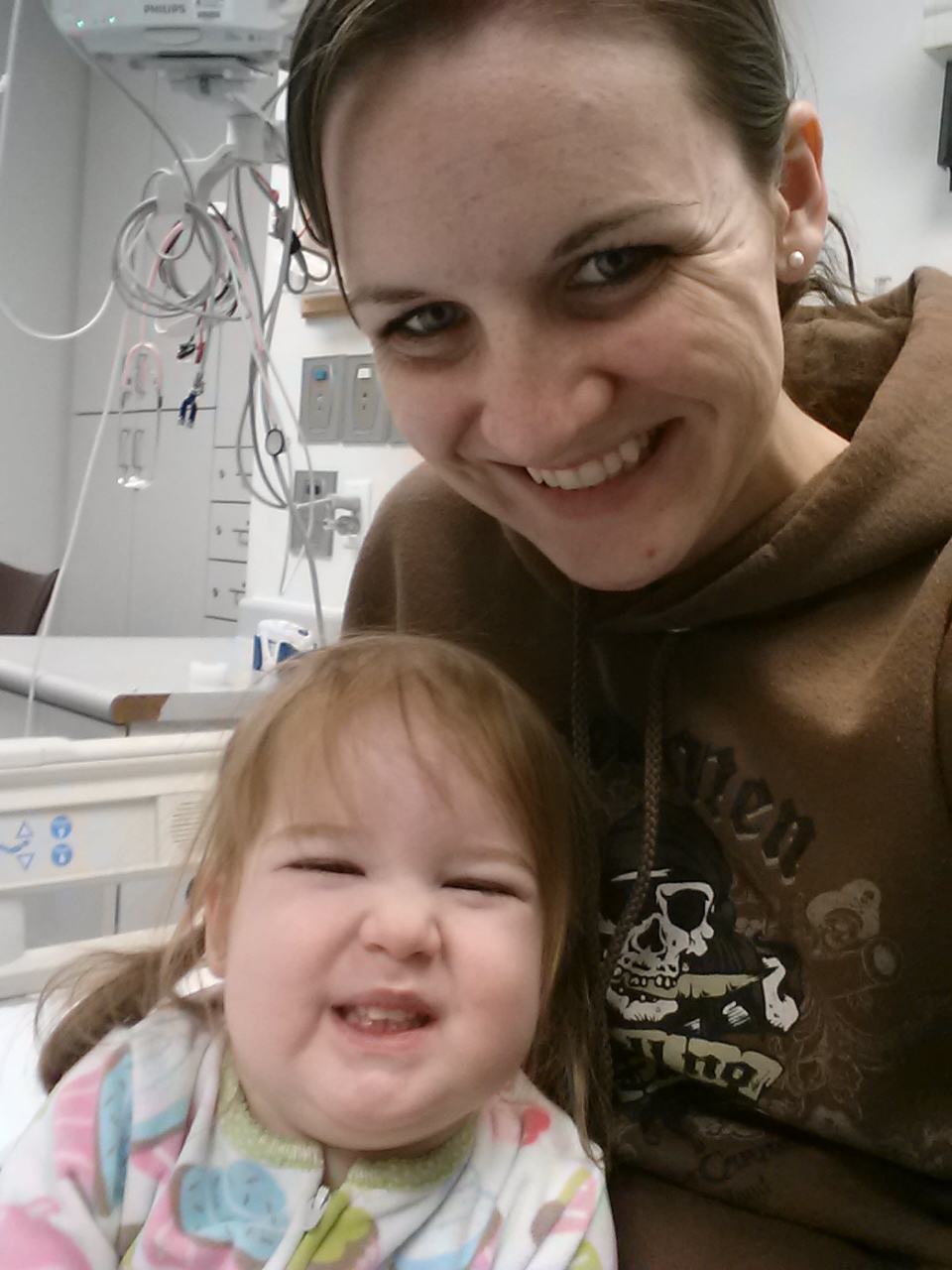
Our clinic appointment for the next phase was scheduled for Wed, Jan 23rd, so we had the home health care nurse come over Tuesday morning to draw blood for labs. When the nurse comes over, she usually takes Molly's temperature, which ended up being 100.2 degrees that morning. She expresses concern for that and I said I would monitor it through the day to see if it got any worse. Molly had just that morning developed a runny nose and coughed occasionally, but I thought she had just caught the cold that I had the week before. That afternoon Big Sis had a dance class I needed to take her to, so I called Grandpa Dean to see if he would come sit with Molly since she was starting to look sick. I got back home with Big Sis at about 3pm, and took Molly's temperature again. It was at 101.4, so I called the clinic to see which ER they wanted me to take her to and they told me that if it was all the same to me I should take her to PCMC so that they could have all her records here at the same place. When Daddy got home at 6pm, I loaded Molly up in the car and headed down to PCMC with the expectation that they would give her a dose of antibiotic and send us home. I didn't even bring my purse, just my wallet, because I figured we wouldn't be gone for long.

When we got to the ER, I told them that she has ALL and that she has a fever, and they brought her right back to a room where they would check her out. I suppose that is one bonus of being a leukemia patient... absolutely no ER waits! Anyway, we got back to the room and they put a blood oxygen monitor on her toe, which showed us that her percentage was in the 70's (should be higher than 80%) so they stuck an oxygen tube on her face and into her nose. She did NOT like that at all! It took her a good 2 hours to get used to it! They also did a quick blood draw from her port and did a nasal swab to test for a variety of diseases, which she didn't like at all either.

Molly just got the oxygen tube put in. No likey.

After about 1 hour waiting in the ER exam room, the resident doctor came in and told me that since Molly had signs of an infectious disease she would be admitted and we'd be taken up to the Immuno-Compromised Services section (ICS - same place we stayed our first week of diagnoses). So I grabbed our coats and Molly's medication bag and we were taken to get a chest x-ray first and then up to ICS and put in a room that had a very good view of the valley. After about an half-hour in the room, the ICS resident came in and told me that Molly's nasal swab showed that she has indeed contracted RSV. She said that her labs showed that she isn't neutropenic (low white blood cells; causing very low ability to fight disease) so that was a good thing, but we'd be staying here for at least until the fever breaks. I asked her how long that would be and she said that most RSV patients start getting better around the 5th day after first showing signs of RSV, which was this day.

Here's the view from our room. I'm definitely asking for this side of the ICS if we ever have to stay here again.
So I started to try to get comfortable. I didn't have my phone charger or even any paper to doodle on, but we did have the Dr Seuss book Go, Dog, Go, so we read that a few times. That first night was tough because I couldn't use my phone and Molly was on an IV so she had to use the toilet every half-hour. Neither of us got very much sleep at all.

The next day, Wednesday, Molly's fever was still in the 102 degree range, her heart rate was in the 150's, she was still on oxygen, her respiratory rate was in the 50's, and her blood pressure was high as well. We put her on an acetaminophen and ibuprofen regimen to keep the fever down. Only the ibuprofen worked, but we could only give that every 6 hours, so we gave acetaminophen at the 3 hour mark in between ibuprofen doses.

Daddy was at home with Big Sis and they both developed stomach aches and diarrhea overnight, so Daddy decided to stay home from work. I had Grandpa Dean stop by and pick up my phone charger and a few other very essential items (my laptop for one, haha!) and drive them down here. The doctors here came in and confirmed that she had RSV and said that the chest x-ray from yesterday showed some splotches, so they suspect she's also got pneumonia and will be doing further tests for that. They put her on an antibiotic and also took a stool sample to see why she suddenly developed diarrhea.

Gotta try to be happy!
Later that afternoon, Daddy called me and told me that his stomach was hurting way too much and that his mom will be staying with Big Sis while his dad takes him to the ER at Davis Hospital. I immediately suspected appendicitis, since he had not had that yet. When he got back from the ER, he called and told me that the doctors there did a CAT scan and didn't find anything except for swollen lymph nodes, so they sent him home with some mild pain medication and instructions to just wait it out. He and Big Sis went back to his parents house for the night so they could help out with the pain. Apparently Big Sis got over her stomach ache pretty quickly, so we knew it was just a coincidence that they both had aches at the same time.

Molly's Tree of Life
On Thursday, all of Molly's vital signs were the same as yesterday; elevated everything. She stopped eating any food so they put her on IV nutrition through her port. She had a blood transfusion just before going to bed last night, so today her color was very nice. They said that her stool sample showed that she had also developed clostridium difficile (C. diff.) which is a pretty common viral spore among hospital patients, and put her on Flagyl to specifically treat that. They also said that they'd put her on a second antibiotic that will help clear up whatever is causing the fever.

Since I was still wearing the same clothes I had arrived here in, I asked for some baby-sitters from my family to come down and sit with Molly while I went home to pack some more clothes and essentials, shower, and make sure the cat was OK. I also talked to my mom about some research I had done here on aromatherapy and she sent down her diffuser and some eucalyptus oil. I had to get permission from the doctors here to use it, and the Integrative Medicine Specialist said I could, but only during very specific times so as not to irritate the other patients here. The specific times were 3-5am and 3-5pm.

I went home to take care of things, and after 4 hours or so, I got back to the hospital and relieved Uncles Ethan and DJ from their duties, organized the hospital room, and tried to start making things comfortable since it was looking like we'd be here at least until Saturday.

Daddy called me again around 8pm and said that he is still in so much pain that he is going to go to a different ER and see what they have to say. About an hour later, I was told that they were going down to McKay Dee hospital so they could do an emergency surgery on his abdomen. I didn't get many details past that, so all night I was worried that I wasn't going to see Daddy again. Molly also had a pretty rough night because of the fever and the fluids she was getting, and all the medications we had to wake her up for. I think it was very surprising that I was keeping my cool this whole time.

Friday morning, Molly's vitals were still the same as they had been, she was getting all the same med's they gave her yesterday, and I was so very tired from the lack of sleep. I found out early in the morning that Daddy was out of surgery and was recovering well. It turns out that he had an organ of sorts connected to his small intestine that a very small percentage of people have as adults called Meckel's Diverticulum. Apparently this thing is something all babies are born with, but it usually disappears soon after birth. His diverticulum was very inflamed and had to be removed. He said that he will be staying at Mckay Dee at least until Sunday.

That afternoon went just the same as it had been all week, and the fellow oncologist that we usually see in the clinic came to see us and explain that we will in fact be delaying the next phase of chemo for 1 week. So that means that she'll be starting the next phase on January 30th.

Saturday was still just like the other days. We did another CAT scan, and later Grandpa Wayne came over so I could visit Daddy in the other hospital, and so I could go see Big Sis and see how she was doing as well. The cat also got some attention.

That night I had a little break-down and maybe scared the nurse a bit. I was crying about how I was worried that Molly wasn't getting any better and we were just making her worse with all the antibiotics and other medications we were forcing into her system. I know why I was so emotional though... I track my menstrual cycle and hormones very closely and this was one of the days I predicted would be a low-hormone day, which would make me depressed and tired for a couple days. I hope the nurses here don't think I'm a nut.

Sunday, yet again all vital signs were elevated. Daddy was discharged from the hospital in the early afternoon. I should mention what activity Molly has chosen to keep herself occupied during the day... Princess Merida in the movie Brave. I'd say we watch that movie probably 4 or 5 times a day here. She even has the verse that the witch says will break the spell on the queen memorized. So do I. "Fate be changed. Look inside. Mend the bonds torn by pride." Tada! Oh, and I officially want the Brave soundtrack. I'm hooked on that music.

The resident doctor here came in that afternoon and said that the newest CAT scan definitely showed that Molly has pneumonia, and I asked for her best guess on how long we could be here. She said that patients with leukemia usually stay for up to two weeks. So that's what I am expecting now... a very long hospital stay with nearly nothing productive in our normal life getting done. At least I have my laptop!

Sunday night was the first night that we were able to keep Molly's temperature down long enough for her to sleep 4 hours at a time. We still had to wake her for medications and to check her blood pressure at midnight and 4am, but I'd say both she and I got very good rest that night!

Feeling a little better!
 On Monday, things were looking the same in the morning, but everything took a turn for the better around noon. Her fever went down, I gave her a bath in the big bathtub here and when we got back and hooked her up to the monitor, they found her oxygen level was staying up so we didn't put the tube back in her nostrils. Grandma Jayne drove Daddy and Big Sis down here so Daddy could bring me one more change of clothes and the hair scissors, and we gave Molly a very extensive haircut. I think it looks absolutely adorable. I was afraid that she wouldn't look like herself, but in fact, the haircut makes her look even cuter, and her very distinct facial expressions are amplified a hundred-fold!


I talked to my mom about another essential oil that could help Molly get better, and she also gave me a homeopathic remedy to give her once or twice. The Integrative Medicine Specialist gave me information on how these additional treatments could help, and also how they could hurt. Armed with this information, I decided to go ahead and use the remedy and essential oils. Also, the Infectious Disease doctors came in and told me that in addition to RSV, they found that she additionally had Coronavirus. So that brings the total illnesses to four. Fun stuff. But she's finally getting better!

Today, Tuesday, Molly is looking very well! Her temperature has been normal for more than 24 hours now. Her heart rate and respiratory rate are very close to normal. She did have to go back on oxygen overnight last night, but she's back off it now that she's awake. The resident doctor came in and told me that Molly is looking very good, and she expects we'll be able to be discharged in a couple days! That is by far much better than 2 weeks! So, all we have to do is get Molly to the point where she can go overnight without oxygen, and she needs to get her appetite back again. She hasn't eaten anything yet, and I keep trying to get her to drink PediaSure, but she still needs the nutritional fluids through her IV port. The oncologist says that we'll probably still start her on the next chemo phase (Interim Maintenance I) tomorrow, but we'll likely delay the methotrexate portion of it 1 week just because of Molly's recent illnesses.

Well, that's that. You'll get another update probably in a week or two, after we've had another clinic visit and chemo treatment. Thanks for reading!

P.S.
If you're wondering about how to donate to the Molly fund (we found out our deductible was misleading and we actually have to pay almost $12,000 per year before the insurance covers anything), we have this nice little yellow-orange button at the top-right of this blog page under Molly's picture that says "Donate." We really really really appreciate everything that has been donated so far, and the time given by several people taking care of a few things for us.
P.P.S.

Please comment if you have anything to say or if you have any additional questions about the post above you would like answered

Saturday, January 12, 2013

Phase 2 Consolidation Clinic Visits


On Jan 2nd we were schedule to visit the clinic at 8am, and then have Molly's lumbar puncture done in the OR at 10am instead of in the RTU because the RTU was completely booked that day. So we get up at a very early hour, made sure Molly didn't eat or drink a thing, and drove up to PCMC. We had to visit the Operating Room check-in first and wait for 30 minutes to be "processed", along with several other children and their parents. Then they sent us back up to the clinic to have labs drawn. After labs, we went back down to the Pre-OR waiting room where they gave Molly some hospital jammies to wear and had me take out her earrings. We got taken back to the OR waiting area where they had several beds and chairs and TVs and some video games. Since I expected we'd only be there for a few minutes, I held Molly in my arms and sat in a rocking chair while she played on my phone. 

Molly fell asleep eventually and the nurse there came to our chair and told me that they expect we'll be taken back at 11:15a. So we waited. And Molly woke up. And wanted juice. And wanted goldfish crackers. And cried. Because she couldn't have anything to eat until after the procedure. 

I'm trying to be a happy mommy with a very unhappy Molly in the OR waiting room.
It got to be 2pm and I finally went to the desk to ask when we were going to be brought back. Of course they didn't know, so they called several people and finally told me that there was one more person ahead of us, and asked if Molly needed to be given anti-anxiety medicine through her port because I couldn't go back with her; they would be carrying her back without me. Well I thought she'd be ok, and I didn't want them giving her any unnecessary drugs anyway. Around 3p, they took her back (and she cried so very much when I put her in the OR nurse's arms) and I went to the parent waiting area, where I waited for only about 40 minutes until they came and told me Molly was awake from anesthesia and I could go see her.

In the post-op recovery area, Molly was on her 3rd bottle of juice, and asking for more. They were so impressed with how thirsty she was (what did they expect? She had waited ALL day for something to drink!) and we were told we could leave as soon as they could figure out how to de-access her port. Seriously? These people see all kinds of patients everyday, and they took 20 minutes trying to "learn" how to take the needle out of her chest (which I had done before and tried to explain it to them myself). They also had to wait to find out what kind of anti-clogging medication to put in her port before taking the needle out (which I had in my bag right there, but they wouldn't listen to someone so unschooled as me). 

Molly with her juice sippy they gave her in post-op.
Needless to say, I was incredibly disappointed with the way everyone in the OR department handle everything. I hope I never have to go back there again.
 _______________________________________

On Jan 9th, we were able to get a spot in the RTU. We had the clinic visit at 10:30a so Molly could have some juice at 9am, but I didn't have any juice to give her so I did some researching on liquid diets and ran across a forum for colonoscopies where I learned that if you take a light-colored jello that's not red and mix it as usual but don't refrigerate it, then it is a good substitute for apple juice or water. So I found way in the back of my cupboard some peach jello, and gave that to her. And the doctor at the clinic said that was fine. 

This week at the clinic, the nurse came in to do the port poke and I had Molly laying down on the bed. I held both her hands as I usually do when they are going to do something she'll likely not enjoy, and she just sat there and watched them the whole time! No crying! The doctor and the nurse agreed that this was quite unusual and I should give seminars to parents on how to calm children down. I realized this week that I had created somewhat of a comfort routine with Molly; holding both her hands, and diverting her attention with songs, and questions about what Big Sis might be doing at grandma's house.

We learned that the RTU had a cancellation and so we got to go down early. Molly insisted on walking down the hall instead of riding in the stroller, so I let her. And the nurses all fell in love with Molly in her pigtails and footsie pajamas, waddling into the RTU.
This week Molly is so much happier than last week!
 While Molly was just waking up from the lumbar puncture this week, one of the nurses came in and expressed concern for a bruise she saw behind Molly's ear where her earring sits. I explained to the nurse that it wasn't a bruise, just a mark from the earring back because it probably has nickle in it. I told her it would wash right off, just like if you had a ring from the quarter machine which left a green mark around your finger. I also got a phone call a few days later from a very concerned oncologist himself who said I shouldn't let Molly sleep in her earrings because it looks like they are bruising her skull and he was worried about possible infection. I explained that it was just discoloration, and then went right over to Molly and took an alcohol pad to the "bruise" and it washed right off. Hopefully I don't get comments on that anymore, as I will try to keep it washed.

We've got 2 weeks off from clinic visits before the next phase. I am still giving Molly Septra on Mondays and Tuesdays to prevent pneumonia, and I am giving her 6-MP (mercaptopurine) every night at least 1 hour after she eats dinner. All her lab results have been excellent, everything is very promising. 

We changed our diet, and Big Sis hates it. She doesn't like the whole wheat spaghetti (neither do we... so we're not having that again) and she doesn't like that she has to eat veggies now. Today we had turkey burgers and roasted organic summer squash. I think we all liked the turkey burgers even better than beef burgers! And I finally tried making rice and steaming broccoli at the same time in my rice cooker... that turned out too easy to fully express how pleased I am. 

I am trying so hard to make this life more normal for myself and my family, but our homeschool and chores are falling behind, I get sad sometimes because I wonder if Molly is just going to die of cancer anyways, and I get sad because we were planning on buying a piano in 1 year, paying off all our debt in about 3 years, and building a house in 5 years, but those all have to be pushed back an unknown amount of years because of this ugly creature dancing with Molly. On my low days, I just want to lay in bed all day and exist without responsibility or desire. It's difficult. But I carry on.

P.S.

If you're wondering about how to donate to the Molly fund (we found out our deductible was misleading and we actually have to pay almost $12,000 per year before the insurance covers anything), we have this nice little yellow-orange button at the top-right of this blog page that says "Donate." We really really really appreciate everything that has been donated so far, and the time given by several people taking care of a few things for us.

P.P.S.

Please comment if you have anything to say or if you have any additional questions about the post above you would like answered.

Wednesday, December 26, 2012

Start of Phase 2: Consolidation

Today we went to visit the clinic after having a full week off of steroids and other chemo drugs. Molly is still taking septra twice a week to prevent a certain kind of pneumonia (yeah! Spelled THAT right the 1st time!), but other than that we have been drug free! Molly's mood and personality has done a complete 180 degree turn-around. It took about 3 days, but she is now the cheerful, playful, excitable toddler she used to be. I really couldn't remember her being so happy before... I had to go back and watch videos I took of her to see how she was before the cancer started this dance with her.

Finally some smiles!
It really is a dance... she isn't fighting cancer, she's dancing with it. And when it's too tired to dance anymore, it will go away and she won't dance with it again. I hear stories of children having relapses and even giving in to the cancer after relapsing. I don't know anything about how their lives were being lived out during that time, because they don't post on their blogs what they were eating or how much exercise they were getting. But I am determined to help Molly's immune system grow as strong as it can to keep the cancer too tired to dance. I will certainly NOT let it enter our lives again because of poor diet and inactivity. This means we won't be eating much sugar, refined grains, red meat, and dairy. I am sure I am leaving a lot of stuff out of that small "do not eat EVER" list, but I don't want to spend too much time on that right now. "EVER?" you say? Well, alright we'll eat them sparingly. But they are no longer going to be a staple in our diet.We just can't strengthen the cancer with those foods anymore.

At the clinic today the nurse accessed Molly's port with the needle and tried to draw blood for labs. The port line under her skin must have been clogged because she just could not get any blood! She pushed and pulled lots of saline through the port hoping to dislodge any small clots, but it didn't work and we ended up giving up on labs for the time being and got sent down to the RTU for Molly's lumbar puncture. We finished that, and returned to the clinic to get our chemo schedule for the next phase, and to try to get a blood draw again. They administered just enough tPA (tissue plasminogen activator) to dissolve any clots in the port line, and then tried to draw blood again. It worked!

Molly had her blood drawn for labs on Christmas eve, and the results from that were all where we wanted them to be. Everything is working so far, Molly is still low-risk, and we are moving on to the Consolidation phase. Here is the treatment for this phase:

  • Second phase: Consolidation. The goal of consolidation therapy is to reduce the number of disease cells left in the body. The drugs and doses used during consolidation therapy depend on the patient's risk factors. 4 weeks long.
    • 1x/day chemo drug by mouth (mercaptopurine or PURINETHOL) (Side effects: low blood counts, possible liver damage)
    • 1x/phase chemo drug through the port implant (vincristine or ONCOVIN) (Side effects: hair loss)
    • 3x/phase on days 1, 8, and 15 lumbar puncture and chemotherapy administration (methotrexate or (TREXALL) (Side effects: low blood counts, nausea, mouth sores, poor appetite)

We had a fantastic Christmas and Molly and Big Sis got way too many presents, but they deserve them anyways. I am so happy that Molly had enough time to detox from the steroids before Christmas day. Big Sis has been saying that she misses playing with Molly, and I am incredibly overjoyed that they could play together with all their new toys all day! I also enjoyed myself some new Doctor Who episodes (yay!). Daddy was scheduled to work at the theater all night though (boo!). I think that Daddy working so often at nights makes the time we have together mean that much more to us, and we use it more wisely.

Molly and Big Sis opening presents on Christmas 2012!


P.S.

Please comment if you have anything to say or if you have any additional questions about the post above you would like answered.


Molly's chemo treatment schedule (abandoned in maintenance cycle 7/8 due to relapse)

Molly's Low-Risk ALL chemo treatment schedule (Protocol AALL1331)
(may differ from other ALL patient's treatment schedules)
  • DONE! First phase: Remission Induction. The goal of induction therapy is to bring the disease into remission. Remission is when the patient's blood counts return to normal and bone marrow samples show no sign of disease. 4 weeks long.
    • 2x/day chemo steroids by mouth (dexamethasone or DECADRON) (Side effects: increased appetite, insomnia, irritability, water retention in face and other possible areas of body, weakness, increased stomach acid)
    • 2x/day antacid by mouth (ranitidine or ZANTAC) (Side effects: no common side effects)
    • 2x/day on Mon and Tue preventative antibiotic for pneumonia by mouth (trimethoprim and sulfamethoxazole or SEPTRA) (Side effects: no common side effects)
    • 1x/week chemo drug through the port implant (vincristine or ONCOVIN) (Side effects: hair loss)
    • 1x/phase chemo drug through the port implant (pegaspargase or PEG L-asparaginase) (Side effects: nausea, weakness, poor appetite, stomach pain)
  • DONE! Second phase: Consolidation. The goal of consolidation therapy is to reduce the number of disease cells left in the body. The drugs and doses used during consolidation therapy depend on the patient's risk factors. 4 weeks long.
    • 1x/day chemo drug by mouth (mercaptopurine or PURINETHOL) (Side effects: low blood counts, possible liver damage)  
    • 1x/phase chemo drug through the port implant (vincristine or ONCOVIN) (Side effects: hair loss)
  • DONE! Third phase: Interim Maintenance I 4 weeks delayed because of RSV. 8 weeks long.
    • 5x/phase (10 days apart) chemo drug through the port implant (methotrexate or (TREXALL) (Side effects: low blood counts, nausea, mouth sores, poor appetite
    • 5x/phase (10 days apart) chemo drug through the port implant (vincristine or ONCOVIN) (Side effects: hair loss)
  • DONE! Fourth phase: Delayed Intensification 8 weeks long.
    • 2x/day on days 1-7 and 15-21 chemo steroids by mouth (dexamethasone or DECADRON) (Side effects: increased appetite, insomnia, irritability, water retention in face and other possible areas of body, weakness, increased stomach acid)
    • 3x/phase chemo drug through the port implant (vincristine or ONCOVIN) (Side effects: hair loss)
    • 3x/phase chemo drug through the port implant (doxorubicin or RUBEX) (Side effects: low blood counts, nausea, mouth sores, hair loss)
    • 1x/phase chemo drug through the port implant (pegaspargase or PEG L-asparaginase) (Side effects: nausea, weakness, poor appetite, stomach pain)
    • 1x/phase chemo drug through the port implant (cyclophosphamide or CYTOXAN) (Side effects: low blood counts, nausea, hair loss, loss of fertility, poor appetite)
    • 1x/day on days 29-42 chemo drug by mouth (thioguanine or 6-TG) (Side effects: nausea, low blood counts, poor appetite)
    • 1x/day on days 29-32 and 36-39 through the port implant (cytarabine or CYTOSAR-U) (Side effects: low blood counts, nausea, mouth sores)
  • DONE! Fifth phase: Interim Maintenance II 8 weeks long.
    • 5x/phase (10 days apart) chemo drug through the port implant (methotrexate or TREXALL) (Side effects: low blood counts, nausea, mouth sores, poor appetite
    • 5x/phase (10 days apart) chemo drug through the port implant (vincristine or ONCOVIN) (Side effects: hair loss)
  •  RELAPSED IN 7TH CYCLE Sixth phase: Final Maintenance. If a patient stays in remission after induction, consolidation, interim maintenance and delayed intensification therapies, maintenance therapy begins. The goal is to destroy any disease cells that remain so that the leukemia is completely gone. 12 weeks long, 8 cycles.
    • 1x/day chemo drug by mouth (mercaptopurine or PURINETHOL) (Side effects: low blood counts, possible liver damage)
    • 1x/phase chemo drug through the port implant (vincristine or ONCOVIN) (Side effects: hair loss)
    • 2x/day on days 1-5 chemo steroids by mouth (dexamethasone or DECADRON) (Side effects: increased appetite, insomnia, irritability, water retention in face and other possible areas of body, weakness, increased stomach acid)
    • 1x/week chemo drug by mouth (methotrexate or TREXALL) (Side effects: low blood counts, nausea, mouth sores, poor appetite)
  • Ongoing treatment: Central Nervous System (CNS) Prophylaxis Chemotherapy. During all three phases of chemotherapy treatment, many patients receive extra chemotherapy to destroy leukemia cells that may have spread to the central nervous system (the brain and spinal cord). This chemotherapy is injected right into the spinal fluid using a lumbar puncture (spinal tap) or an Omaya reservoir (a device placed under the scalp). It is called intrathecal chemotherapy.
    • DONE! Day 1 and 8 of Induction - lumbar puncture and chemotherapy administration (methotrexate or TREXALL) (Side effects: low blood counts, nausea, mouth sores, poor appetite)
    • DONE! Day 1, 8, and 15 of Consolidation - lumbar puncture and chemotherapy administration (methotrexate or TREXALL) (Side effects: low blood counts, nausea, mouth sores, poor appetite
    • DONE! Day 31 of Interim Maintenance I - lumbar puncture and chemotherapy administration (methotrexate or TREXALL) (Side effects: low blood counts, nausea, mouth sores, poor appetite
    • DONE! Day 1 and 29 of Delayed Instensification - lumbar puncture and chemotherapy administration (methotrexate or TREXALL) (Side effects: low blood counts, nausea, mouth sores, poor appetite
    • DONE! Day 1 and 31 of Interim Maintenance II - lumbar puncture and chemotherapy administration (methotrexate or TREXALL) (Side effects: low blood counts, nausea, mouth sores, poor appetite
    • RELAPSED IN 7TH CYCLE Day 1 in each 12 week cycle of Final Maintenance - lumbar puncture and chemotherapy administration (methotrexate or TREXALL) (Side effects: low blood counts, nausea, mouth sores, poor appetite)

Saturday, December 22, 2012

Induction Phase

Week 1
When we brought Molly home it was a little weird because I didn't know what life was going to be like from now on. She still had her port in and the Home Health Care nurse came to show me how to administer her ceftazidime medication. Molly was still not walking so we had to carry her to the toilet every time she thought she had to go (which was VERY often... ) and she had that increased appetite because of the dexamethasone steroids so we had to carry her to the kitchen often to find something she wanted to eat. We found out quickly that her specific food craving was anything that had tomatoes in it... ketchup, spaghetti sauce, pizza, etc. If she had macaroni and cheese, it had to have ketchup on it. We also learned that it was best to make spaghetti noodles and macaroni & cheese in bulk so it was really quick to dish some out and reheat it real quick for her.

Week 2
We visited the Hematology/Oncology Clinic for the first time on Wed Nov 28th. Big Sis was at Ama's house because they don't allow siblings to come to the clinic. They took blood for her labs and then started her on a platelet transfusion before they could give her the vincristine chemo. The lab results came back and her red blood cells were pretty low but the doctors decided to hold off one more week to give her a transfusion for that. They sent us down to the Rapid Treatment Unit (RTU) to do a spinal tap again in Molly's back. For the rest of the week we just basically tried to stay busy so we didn't get bored. Even though we still took Big Sis to her tumbling and dance classes, and went shopping and whatever else we needed to do, it felt like we were just living our lives around Molly's medication and potty schedule. We had steroids first thing in the morning, ceftazidime into her port right after that, amlodipine for blood pressure at noon, ceftazidime into her port again in the afternoon, steroids at dinner time, and ceftazidime into her port at midnight. Molly was getting crankier and crankier as the week went by. We noticed that her face started getting really puffy and her belly also got big. Her hair was starting to fall out more too. We also had to have the home health care nurse come by to change Molly's port line (remove the needle, clean the area, stick a new needle and line into the port through her chest) because it needs to be done once a week.
Hair is getting thinner, cheeks are getting fatter...

Week 3
Visited the clinic again on Wed Dec 5th. They took labs through her port again, and administered the vincristine. Then we were taken back to the transfusion room where they put Molly on red blood cells and we sat there for a couple hours. Molly took a nap and I read a book. When that was finished, we had to stay for a half hour to make sure Molly didn't have an allergic reaction to the donor blood, and the oncology doctors came to tell us that we can stop the ceftazidime through her port and remove the port line. We went home and resumed life as best we could.  Things seemed a bit more relaxed without the 3x/day port medication, but I still got basically nothing done around the house because Molly needed food so often and every time she needed to pass gas she thought she had to use the toilet. I think I lost 3 lbs this week from carrying chubby Molly to the bathroom, kitchen, living room, Mommy's bed, etc. Molly gained 3 lbs from all the food and the water retention in her face and belly.

Chubby cheeks and belly
Week 4
Clinic visit on Wed Dec 12th. Big Sis spent the day at Grandma Jayne's this week. At the clinic they took labs and administered vincristine again. It was a quick visit this week since we didn't have any outpatient procedures in the RTU or any transfusions. The rest of the week was pretty much the same as last week but Molly was even more cranky and even more hungrier. We ran out of ketchup finally (that stuff really isn't healthy at all, especially for a cancer patient) and Molly had me carry her to the kitchen several times because she just *knew* that we had ketchup hiding somewhere. Molly's face is so puffy I cannot even recognize her. her hair is still falling out a little at a time, but she doesn't have any glaring bald spots yet. I was counting down the days to Dec 18th, her last dose of steroids for this phase. It was a tough week for me, because my mood hormones were low and it made me tired and irritable, which doesn't mix well with a toddler on steroids. I had to apologize several times to Molly for losing my cool and yelling at her.

Wed Dec 19th, we went to the clinic and they took blood for labs again. Her levels were improving as much as they should be. They didn't give her any vincristine this week, but they did send us down to the RTU to do a spinal tap again and to do a bone marrow aspirate (just take the marrow, instead of a chunk of bone as well). The oncology doctor gave me some papers to read through for the COG study and said that if we consented to participating in the study, we would be randomized to one of two arms of treatment; the standard treatment protocol with all the standard chemo treatments and clinic visits once a week, or a new study protocol which uses more doses of one chemo treatment and less variety of other chemo treatments and we would have to do six three-day hospital stays in the next 5 months. The doctor told me that I had a week (until Dec 26th) to make the decision to either opt out of the study or to consent and have the study decide which protocol we'd be using.

In the last couple of days, Molly's mood has improved hundred-fold and she was laughing and playing with toys for the first time in over a month yesterday, 3 days after her last steroids dose. Her face is still puffy, but it is going down. She stopped asking for ketchup and other tomato foods and is back to eating toast and cereal for breakfast instead of spaghetti. She still has most of her hair, but it is noticeably thinner. No bald spots yet.

Aww... Molly's hair found a new home (this is from one brushing)

I'm so happy that we are done with the month of steroids, and that Molly is responding to the chemo. Whichever treatment arm we end up on next week, we will have about 8 week-long "pulses" of steroids over the next 2.5 years, but I think we can handle it now that I know what to expect.

Until next time... we love you and know you are thinking of us.

P.S.

Please comment if you have anything to say or if you have any additional questions about the post above you would like answered.
Left: Molly at week 2.                  Right: Molly at week 5.


Saturday, December 15, 2012

Molly's first hospital stay, Pt 3

Thursday (Thanksgiving) through Saturday were pretty calm at the hospital. We had a few visitors (Nana, my favorite uncles Kristian and Mac and their amazing wives, and Daddy's boss even stopped by), but mostly it was long and boring. The doctors said that if her lab results on Saturday were no worse than before, she would be able to go home after they gave her the first pegaspargase chemo treatment. We spent those last three days at home cleaning the house and bleaching all the toys, and at the hospital keeping Molly happy with treats and activities, and I created a new crochet pattern for a "chemo cap," which I tested on Big Sis and found I made it too big.

Molly was now being given steroids three times a day, and because her blood pressure was up she is also taking 1x/day amlodipine (NORVASC). Molly had a mild fever right after her surgery and so the doctor also prescribed a 3x/day ceftazidime (FORTAZ) to be given through her IV port for 14 days.

The social worker gave us a lot of information on networks for parents and applications for financial aid. There was a lot of stuff in there such as Make-a-Wish Foundation, American Cancer Society, and even a medicaid application (because technically for the next 2.5 years Molly is disabled or something).

We did ask one of the oncologists how soon Molly would lose her hair, and she said that by the end of the induction phase her hair will be noticeably thinner. 

On Friday was Molly's 2nd birthday, and the social worker asked permission to have the nurses in to sing to her and give her some presents. We figured it would be fine and they sang fantastic and even gave Big Sis a present for being such a great big sister. We didn't really make a big deal of her birthday since we were planning on throwing her a big party after we got home.


That last morning, the wonderful nurse on duty went through the parent education test with me (she said Molly wouldn't be discharged until we finished the test) and went through which medications do what and when they are to be taken. She then showed me how to administer the ceftazidime into Molly's IV port. After we finished all that, I felt I was ready to take some sort of nursing exam and start work! The oncologist came in around noon to administer the pegaspargase chemo and then we watched for any allergic reactions for 2 hours.

Precisely at 4:00pm on Saturday we were allowed to take Molly home. That drive home was surreal because for the whole week it was like we were living in a strange dream that I was going to wake up from at any moment. And then suddenly we're in the car with Big Sis and Molly and Daddy and me and we're going HOME!

Molly sure was happy to get home and get back to her usual activities.

All of Molly's medications, minus the ceftazidime.
P.S.

Please comment if you have anything to say or if you have any additional questions about the post above you would like answered.

Sunday, December 09, 2012

Molly's first hospital stay, Pt 2

Wed, Nov 21st, at about 6am one of the many wonderful nurses that took care of Molly during our stay at PCMC told us that Molly was scheduled to go into the OR at 7:30am. We were pretty excited about that because it meant Molly didn't have to go all day without food. The nurse had me take Molly's earrings out and we wheeled her bed through the halls and down to the 2nd floor where they put us and her bed into a room to wait for the anesthesiologist to come get her.
 
In the pre-operating room. She's smiling under that mask.
We didn't tell her what was happening because I know how awful anticipation can be, so when the anesthesiologist came to get her, we told her he was going to take her into another room and told her to have fun. We made sure not to make a big deal of it, and we also made sure the anesthesiologist knew that Molly loves her frog blankie, and to say "frog blankie" and "pink blankie" not like it's a description of the blanket, but like it's the blanket's name.

We were directed to the parent waiting room, where we checked in and told the front desk that we'd be going up to our room to eat breakfast instead of waiting downstairs for the 2 hours Molly would be in surgery. For the next 2 hours we pretty much relaxed. We ate breakfast in Molly's room, then I grabbed my cell phone charger and we went down to the waiting room. The surgeon who was placing the port came in shortly after we got there and told us he was finished... which surprised us, because it had only been about 30 minutes. But then we found out they had not done the lumbar puncture or bone marrow biopsy yet. So we waited in that room for the remaining time and right around the 2 hour mark the front desk called for "one parent for Molly" and James went to sit with Molly as she woke up from the anesthesia. I waited for what seemed like forever before the front desk called "Molly's mom to the front desk."

The halls on the 2nd floor have pictures of things like kites or hot air balloons on the floor, and I was told to walk down the hall to the hot air balloon and wait there where they'll bring Molly out. In a couple of minutes the doors opened there and Daddy and Molly came out. She didn't look miserable or anything, so I said hi, and I love you, and how are you, and we walked back up to her room.

When we got back to the room, we were told that her spinal fluid test was negative for cancer cells, so that tells us that the cancer hasn't traveled to her brain. They'll be testing her spinal fluid periodically throughout the treatment to make sure it remains negative. We were given an outline for the treatment Molly will be getting.

Quick lesson: Molly's chemo treatment schedule

  • First phase: Remission Induction Chemotherapy. The goal of induction therapy is to bring the disease into remission. Remission is when the patient's blood counts return to normal and bone marrow samples show no sign of disease. 4 weeks long.
    • 2x/day chemo steroids by mouth (dexamethasone or DECADRON) (Side effects: increased appetite, insomnia, irritability, water retention in face and other possible areas of body, weakness, increased stomach acid)
    • 2x/day antacid by mouth (ranitidine or ZANTAC) (Side effects: no common side effects)
    • 2x/day on Mon and Tue preventative antibiotic for pneumonia by mouth (trimethoprim and sulfamethoxazole or SEPTRA) (Side effects: no common side effects)
    • 1x/week chemo drug through the port implant (vincristine or ONCOVIN) (Side effects: hair loss)
    • 1x/month chemo drug through the port implant (pegaspargase or PEG L-asparaginase) (Side effects: nausea, weakness, poor appetite, stomach pain)
  •  Second phase: Consolidation Chemotherapy. The goal of consolidation therapy is to reduce the number of disease cells left in the body. The drugs and doses used during consolidation therapy depend on the patient's risk factors. 4 to 8 months long.
    • We don't have the treatment schedule for this yet. 
  •  Third phase: Maintenance Chemotherapy. If a patient stays in remission after induction and consolidation therapy, maintenance therapy begins. The goal is to destroy any disease cells that remain so that the leukemia is completely gone. 2 to 3 years long.
    • We don't have the treatment schedule for this yet.
  • Ongoing treatment: Central Nervous System (CNS) Prophylaxis Chemotherapy. During all three phases of chemotherapy treatment, many patients receive extra chemotherapy to destroy leukemia cells that may have spread to the central nervous system (the brain and spinal cord). This chemotherapy is injected right into the spinal fluid using a lumbar puncture (spinal tap) or an Omaya reservoir (a device placed under the scalp). It is called intrathecal chemotherapy.
    • Day 1 of Induction - lumbar puncture and chemotherapy administration
    • Day 8 of Induction - lumbar puncture and chemotherapy administration
    • Day 29 of Induction - lumbar puncture and chemotherapy administration
    • We don't have the treatment schedule for any after this yet. 
 
The bone marrow biopsy was to test further what classification of ALL Molly has; and the results came back as Early pre-B cell ALL.

Quick lesson: Classification of childhood leukemia
Doctors have found that lab tests provide more detailed information about the subtype of ALL. These tests help divide ALL into groups based on the immunophenotype of the leukemia, which takes into account:
  • The type of a kind of white blood cell (lymphocyte) (B-cell or T-cell) the leukemia cells come from
  • How mature these leukemia cells are 
There are 4 main subtypes of ALL, as shown below
  • Early pre-B cell; 60%-65% frequency
  • Pre-B cell; 20%-25% frequency
  • Mature B cell; 2%-3% frequency
  • T cell; 15%-18% frequency
B-cell ALL is the most common. T-cell ALL affects boys more often than girls and it affects older children more than does B-cell.

Quick lesson: (Source: http://www.cancer.org/cancer/leukemiainchildren/detailedguide/childhood-leukemia-prognostic-factors)

Prognostic factors for children with ALL
Different systems are used to classify childhood ALL risk. In one of the more common systems, children with ALL are divided into standard-risk, high-risk, or very high-risk groups, with more intensive treatment given for higher risk patients. Generally, children at low risk have a better outlook than those at very high risk.

While all of the following are prognostic factors, only certain ones are used to determine which risk group a child falls into. (The first 2 factors – age at diagnosis and initial white blood cell count – are generally considered the most important.) It's important to know that many children with one or more poor prognostic factors can still be cured.
  • Age at diagnosis: Children with B-cell ALL between the ages of 1 and 9 tend to have better cure rates. Children younger than 1 year and children 10 years or older are considered high-risk patients. The outlook in T-cell ALL isn't affected much by age.
  • White blood cell (WBC) count: Children with ALL who have especially high WBC counts (greater than 50,000 cells per cubic millileter) when they are diagnosed are classified as high risk and need more intensive treatment.
  • Subtype of ALL: Children with pre-B or early pre-B-cell ALL generally do better than those with mature B-cell (Burkitt) leukemia. The outlook for T-cell ALL seems to be about the same as that for B-cell ALL as long as treatment is intense enough.
  • Gender: Girls with ALL may have a slightly higher chance of being cured than do boys. As treatments have improved in recent years, this difference has shrunk.
  • Race/ethnicity: African-American and Hispanic children with ALL tend to have a lower cure rate than children of other races.
  • Spread to certain organs: Spread of the leukemia into the spinal fluid, or the testicles in boys, increases the chance of a poor outcome. Enlargement of the spleen and liver is usually linked to a high WBC count, but some doctors view this as a separate sign that the outlook is not as favorable.
  • Number of chromosomes: Patients are more likely to be cured if their leukemia cells have more than 50 chromosomes (called hyperdiploidy), especially if there is an extra chromosome 4, 10, or 17. Hyperdiploidy can also be expressed as a "DNA index" of more than 1.16. Children whose leukemia cells have fewer chromosomes than the normal 46 (hypodiploidy) have a less favorable outlook.
  • Chromosome translocations: Translocations result from the swapping of genetic material (DNA) between chromosomes. Children whose leukemia cells have a translocation between chromosomes 12 and 21 are more likely to be cured. Those with a translocation between chromosomes 9 and 22 (the Philadelphia chromosome), 1 and 19, or 4 and 11 tend to have a less favorable prognosis. Some of these "poor" prognostic factors have become less important in recent years as treatment has improved.
  • Response to treatment: Children whose leukemia responds completely (major reduction of cancer cells in the bone marrow) within 1 to 2 weeks of chemotherapy have a better outlook than those whose leukemia does not. Children whose cancer does not respond may be given more intensive chemotherapy.


Molly is a low risk patient. She was 1 week away from her 2nd birthday at diagnoses, her white blood cell count was 6,200 per cubic milliliter, she has early pre-b cell ALL, she's a female, and the cancer hasn't spread to her spinal fluid.

Just out of surgery! It went very well.

Molly and Big Sis doing some coloring. It's much easier now that the hand IV is out!

This is a video of Molly hooking her cords up again after a trip to the bathroom. She insisted she do the task herself... if we even presumed to do it for her, she would get very upset!

All the family visited again, and since Nana was in town for Thanksgiving the next day, she came to visit and brought gifts and get-well cards from family up in Idaho. Daddy and I decided to take Big Sis home to our house for the rest of the week, so I went home Wednesday night to clean up the house, shower and get some rest while Daddy was at the hospital with Molly, and the next day Big Sis and I went back to the hospital.

To be continued, of course...

P.S.

Please comment if you have anything to say or if you have any additional questions about the post above you would like answered.